Monday, October 9, 2017

Devil Ray


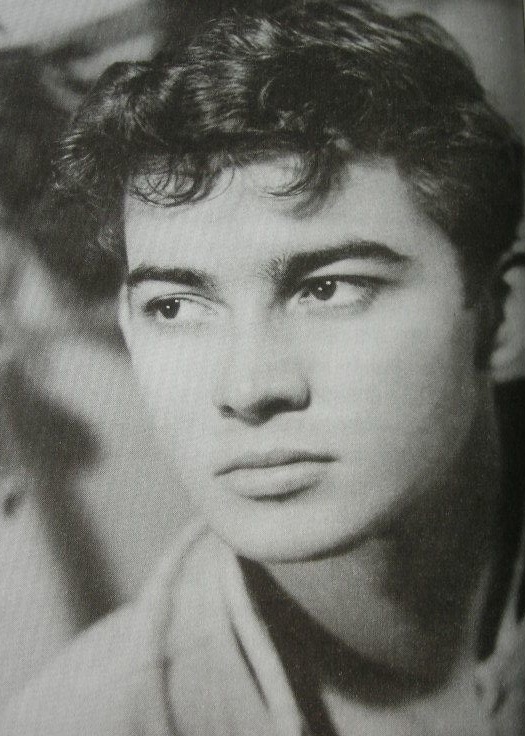
The other day while channel surfing, I stumbled upon an old film that I had never seen before: Ten North Frederick (1958), based on the popular John O’Hara novel. This A-list picture starred Gary Cooper and Geraldine Fitzgerald, as well as a young Diane Varsi. Suzy Parker played Cooper’s love interest. So how could I not watch? But the big surprise in the cast was a young actor that I vaguely recognized from other pictures named Ray Stricklyn. He was cast as Cooper’s tortured soldier son, battling a drinking problem and a massive chip on his shoulder due to his father’s highhanded negligence, and his mother’s firm hand.


Intense, trim and wiry, with dark, sultry good looks, Stricklyn oozed a dynamic sensuality that resonated with me. This was the epitome of juvenile angst that movies in the 50s thrived on.  Only here, it was obvious to me (and countless other like-minded souls, I'm sure) that there was something other than delinquency seething under this sad young man’s skin. Stricklyn gave off unmistakable gay vibes that served to enhance his performance rather than distract from it. He used his ambivalence to make the part stand out. For a youth to hold his own against the likes of Gary Cooper and Geraldine Fitzgerald was remarkable unto itself. But this young actor had something unique — a kind of feral rage — that I found instantly appealing and intriguing.


I looked up Ray Stricklyn’s IMDB record to find out where else I might have seen his face. One of his first roles jumped out at me. He had played the brother of Debbie Reynolds in the Paddy Chayefsky classic, A Catered Affair, one of my favorite of Bette Davis’s later films, above. Almost a cameo role, Stricklyn’s turn as a high-strung, but likable, teen had stuck in my mind. And apparently in Bette Davis’s too. She and Stricklyn, I learned, hit it off and remained close friends for many years.

The juvie classic Crime in the Streets (1956), directed by Don Siegel, starred John Cassavetes and former Yalie James Whitmore. Sal Mineo is the stand-out in a breakthrough role as a teen under Cassavetes's thumb, but keep your eye out for a young Ray Stricklyn as one of the gang members. 


Curious about his career, I tracked down some of his other roles, including the campy horror film The Return of Dracula (1958), above, co-starring Francis Lederer, in which Ray, somewhat less convincingly played the young starlet's love interest. He also appeared in a couple of westerns, such as Young Jesse James (1960), and played Billy the Kid on a Bronco TV episode, below. 


I also did a quick Google search. One link popped out at me and made my jaw drop. Ray Stricklyn had been on the notorious “Spy List” back in 1990, along with Milton Berle, Kevin Costner, Tommy Lee, Don Johnson, Mick Jagger, Tom Jones, and Rudolph Valentino.


One didn’t need to be a rocket scientist to figure out what these men all shared in common, especially since Tommy Lee would later show the world his credentials in explicit videos with Pamela Anderson. I certainly remembered Spy magazine’s list — which had created a sensation (this was before the days when things went viral online) — but had no memory of Ray Stricklyn, who it turned out, was the only one on the list who was openly gay. (Valentino was a bit more complicated.)

I decided to order the autobiography Stricklyn had written a few years before his death. Entitled Angels & Demons, One Actor’s Hollywood Journey (1999), the book is a fiercely candid, trenchant peek into the Hollywood studios's twilight years, and his struggles with his homosexuality. While many recent memoirs by gay actors have been informative and eye-opening — in particular Farley Granger’s Include Me Out, and Tab Hunter’s Confidential — Stricklyn’s autobiography goes far beyond theirs in terms of self-examination and soul-searching, and chronicles the highs and lows of a failed Hollywood career with an honesty that is at times painful to read.


While not the juicy homoerotic exposé one might expect (Tony Perkins’s bio, Split-Image, by Charles Winecoff, is much more rewarding in that regard), Stricklyn’s memoir does have its amusing kiss-and-tell moments, especially during an incident in which he and James Dean were lounging together in Central Park, with Dean’s head in Stricklyn’s lap. Dean suddenly pulled Stricklyn down and kissed him full on the lips. It’s a tender moment between two friends, nothing more. But that was the effect Stricklyn seemed to have on those around him, although he recounts a hilarious moment in Lee Marvin’s dressing room when the unpredictable actor pulled out a gigantic phallic-shaped dildo and nearly attacked him with it. Stricklyn didn’t stick around to find out what precisely Marvin had in mind.

While working with some of the hottest actors of his day (including Dee Pollock, Bill Smith, Ty Hardin, Paul Newman and “cocky actor” Nick Adams, with whom he did not get along), Stricklyn did not mix work with pleasure often. He lists among his lovers Tab Hunter (no surprise there); Tony Perkins (a quickie in Central Park); Craig Hill, a handsome TV idol (Whirlybirds) who went on to make westerns in Spain and later married; and his lifelong partner David Galligan, an antiques dealer who became a noted stage director. Stricklyn didn’t shy away from sex, but it was not his number one preoccupation. He tried to go straight (via psychotherapy) or at least to swing both ways for a while (flirting with Joan Collins), but that only exacerbated his already significant drinking problem. Ray Stricklyn had several demons struggling inside him.


But it’s clear that the perception of his homosexuality had a major impact on his career. While he landed good roles in important films such as The Proud and the Profane, The Remarkable Mr. Pennypacker (playing Clifton Webb’s son), The Big Fisherman, The Plunderers, and The Lost World, he struggled to find regular work. Despite garnering accolades in almost every role he took on, Stricklyn was not given the leading roles he needed to firmly establish himself in Hollywood. The demise of the studio system was a major factor since his contract was not renewed when Fox ran into financial problems.


But watching his performances, one can’t help but be struck by the almost androgynous appeal Stricklyn showed — sort of a cross between the angst-ridden rebel of James Dean and the sensual vulnerability of Sal Mineo — and wonder if he was not a victim of his times. He did do a lot of TV work and had significant success in several stage plays, including Compulsion and Capote’s The Grass Harp, below. But his career seemed to be a never-ending stream of hopeful fits and false starts.


Stricklyn gave up acting for a time, working with the legendary PR mogul, John Springer. Stricklyn’s memories of promoting Peggy Lee, Mae West, Henry Fonda and Bette Davis are some of the highpoints in the book. But he yearned to return to the stage. It was Bibi Andersson, of Ingmar Bergman fame, who spurred him on to give acting another try. After several potent parts in plays, including Vieux Carré, for which he won the Los Angeles Drama Critics award for best actor, Stricklyn wrote and starred in a one-man show about that work’s author, Tennessee Williams. The show, Confessions of a Nightingale, toured the country for years, opened on Broadway (even the irascible John Simon liked it) and made Ray Stricklyn a bona fide star.


It’s gratifying to see a man fulfill his dreams. But apparently from what I’ve read elsewhere, Stricklyn never was able to shake off his demons. He did get sober in AA, and settled down to a happy partnership with David Galligan. But he continued to be wracked with worries and anxieties, smoked four packs of Kools a day, which led to a severe case of emphysema that eventually killed him in 2002. One friend wrote that even as he approached death, Stricklyn never lost his edge. He greeted death with rage, not submission.


Just for the heck of it, I looked up Ray Stricklyn on YouTube to see if any of his old TV shows might be posted. And lo and behold, one was: an episode of the 1957 inspirational series, Crossroads, entitled “A Call for Help,” above, starring Richard Carlson and a young Michael Landon. Stricklyn plays a Mama’s Boy who is picked on by a local gang led by Landon.


To prove he is not the “sissy” they repeatedly call him, Stricklyn grabs his father’s gun and shoots Landon and another boy, killing the latter. He is put on trial and defended on the theory that he was fighting more substantial inner demons (which I presume to be 50s doublespeak for homosexuality).


It’s a fun episode to watch, and one that underscores all of Stricklyn’s strengths, weaknesses and ultimately his enormous potential. Of course, it was the sexy bully Michael Landon who became a superstar. One can’t help but wonder what might have happened had their roles been reversed. 

Friday, March 17, 2017

The Eyes of Taos


While exploring the vast contents of the Harry Ransom Center in Austin during a month-long sojourn one joyful March a few years ago, I was captivated by the diaries of a little-known writer named Spud Johnson. These journals document the Taos art scene, as well as American gay life in the 30s and 40s, in a way I had never come across before.

The collection includes hundreds of photographs documenting Spud's life in Taos. There are pictures of him posing with Frieda and D. H. Lawrence (anachronistically dressed in thick woolen suits in the desert); Mabel Dodge and Tony Luhan; young men like Haniel Long, Joel Lacey, Lucius Kutchin, artists Loren Mozley, John Goldmark, as well as local youths Rafael and Patricio who resemble models handpicked by Edward S. Curtiss.


I actually had first heard of Spud Johnson ages ago back when I was obsessed with anything to do with D. H. Lawrence, especially his days recovering from tuberculosis in Taos, New Mexico. As a college student, enthralled with Lady Chatterley's Lover and the like, I read all about Lawrence's life among the pueblos and his wacky circle of friends there, in particular Mabel Dodge Luhan, the heiress who had rocked the world with her torrid love affair with John Reed, then settled down with an American Indian in Taos.


One of her closest friends was a little known poet and publisher, Walter Willard Johnson, nicknamed Spud, who occasionally put out a much-admired journal called Laughing Horse. A recent book about that venture, Spud Johnson and Laughing Horse, by Sharyn Rohlfsen Udall, describes him as "the aesthetic and intellectual conscience of Taos." But it reveals very little about Spud Johnson's colorful personal life.

I found out more on my own. He was born on June 3, 1897 in Mount Vernon, Illinois but grew up in Greeley, Colorado. His father John Smith Johnson was from Fredonia, Kentucky and had built up a successful lumber business. His mother, (née) Susan Wiggington, was also originally from Kentucky. Spud had a brother Van Elbert and a sister Helen Gladys. His cousin Lila Wheeler was adopted by the family and raised as a sister. From an early age, Walter was dubbed "Spud" by his family. In fact, that is the name he used on his Social Security card. He studied at Colorado State Teacher's College in 1916, where he wrote for the school paper and worked as a cub reporter for the Greeley newspaper. He then attended the University of Colorado in Boulder, and found work at the Pueblo Chieftain where he apprenticed in journalism.

Eager to broaden his horizons, he moved to the University of California in Berkeley. There, with friends, he started up a small press pamphlet, Laughing Horse, known for its biting and flippant tone, which immediately raised the hackles of university authorities by opposing certain school programs. Spud became the companion of one of his poetry teachers, Witter Bynner (below), a noted writer who also taught at UCLA. Bynner helped Spud find a job as a secretary at the esteemed but highly secretive Bohemian Club.


By 1922 the two traveled to Santa Fe, NM, where Spud met D. H. Lawrence through Bynner and traveled with the storied author and his wife Frieda to Mexico. In a short time he had relocated with Bynner to Taos, the hub of a lively burgeoning literary scene, where he soon fell in with the indomitable Mabel Dodge Luhan, who'd first put Taos on the map. (Mabel, Frieda and Dorothy Brett, below.)


Spud became Mabel's private secretary and settled down there permanently. He eventually built a small adobe home, La Placita, where he lived for 40 years until his death in 1968. It later became a popular, if funky, bed and breakfast, The Laughing Horse Inn.


In those early years in the 20s, Spud wrote constantly and his work was published in Poetry, Pan, Echo, Palms, and The New Republic. Rydal Press published a selection of his works in 1935, entitled Horizontal Yellow. Later he would toil in Manhattan for a year at The New Yorker, penning pithy "Talk of the Town" pieces. He preferred the Southwest and hurried back to Taos.

But it was primarily as a friend of the famous that Spud achieved lasting notoriety. He appears sporadically as a character in books by Lawrence and Mabel Luhan and Dorothy Brett, and was frequently sought out by visitors who relished his connections as well as his hospitality. He was an enigma to many. Lady Dorothy Brett wrote of him: "There is something oddly Chinese in the narrow shape of the face, of the features, that are more chiseled bones than flesh. He might be a Chinese ascetic from some old, old Mandarin family: the dark, smooth hair should end in a pig-tail, I think to myself. And not only to look at, is he Chinese to me: he has also something of their reserve; he keeps his inner life hidden away, carefully guarded."

That inner life was not hidden in his date books and journals. These diaries, carefully preserved at the Harry Ransom Center, cover a wide turf, starting off in the 1910s, and contain a startling "Declaration of Independence" in 1918, which sounds oddly like a defiant statement of coming out. Several pages are torn out of the diary in those early years, but as they progress they become more confident and far more candid. Spud details his affair with Myron Brinig, the now nearly forgotten writer who at the time was ranked alongside Thomas Wolfe.


Brinig was living with his boyfriend, artist Cady Wells, at the time but that did not preclude several jumps in the hay with Spud which the latter described as "bedroom athletics." He seemed to genuinely love Myron, below, his "ape-like" "Roumanian Jew."


Spud's explicit diary entries are extremely daring for their day and an invaluable guide for any scholar of so-called "queer studies" looking into the mind-set of homosexual life at the time. Despite the prevailing prudishness, Spud pulls no punches and reveals all. Some of his observations are campy and self-revealing, primarily plaintive regrets that he wasn't promiscuous enough, and had failed to pick up a stray boy on the street. The picture he paints is one of a very active and amusing gay scene of transients and trend-setters, but also a lonely life of yearning and regret.

In August 1934 Spud describes vividly having sex in the lobby of the Sagebrush Inn with a young man who worked there. Not long after he reveals seducing one of Mabel's native American cowboys, "topping" him in a tepee during a camping trip. Lust became an obsession for him: he keeps thinking of "white-limbed boys and dark-skinned lads" and "muscles that get hard when you touch them." (Below, Bynner and two local youths, Patricio and Rafael, from New Mexico.)


The diaries reveal a world of endless intrigue, drunken debauches, and constant fights with female admirers such as Alexandra Fichen, but also of boredom. This was before television and evenings were usually devoted to listening to radio, or spent at local dances, in bars or playing games like Anagrams and Charades or Solitaire. Spud expends a great deal of energy trying to "vamp" the local boys. He compares his notes to a schoolgirl's diary, especially after a failed attempt to pick up a drunken pal at a dance. A few weeks later, he yearns for a friend who instead has "hot pants" for some "tramp".

What comes through most in these diaries is Spud's sweet sense of humor. He's provocative, such as the time he threw flowers at the feet of a native Indian boy he fancied as he passes by during a parade. Much of the time, Spud generously takes in strays and younger men who are just passing through town and treats them with respect and an almost maternal care. But he clearly relishes his privacy and few of them stay very long.

By the mid 30s, he asks why he has no lovers? "I know I'm no longer either young or attractive, and yet everyone seems to like me." But soon he is befriended and bedded by Forbes Cheston, a wealthy Englishman who would later become a dominant figure in AA. There's also the episode in 1937 when he picks up a "strangely Aztec" bar boy and has wild sex with him under the moonlight behind a chapel, adding characteristically, "He practically nailed me to the old church wall."

The diaries, when not revealing the gay subterranean set, also revel in the literary life in New York which he visits in 1934. He hangs out with Carl Van Vechten and Effie Stettheimer. He describes Virgil Thomson in unflattering terms as pudgy with pop eyes and a high voice. "Didn't like him very much." Driving back to Taos, he picks up a hitchhiker with such bad body odor that he has to drive with the windows wide open. All of his road trips are sagas of overheated water tanks, flat tires and blow-outs.


Patrick White, above, the noted Australian author, visited with Spud in the late 30s and began an intense romantic affair with him on the eve of World War II. Some of his love letters are quoted in Spud's diaries and are very touching. But ultimately White met the man he would spend the rest of his life with and moved on, never looking back. Spud was left once again alone.

Max Evans, the author of the recent novel Bluefeather Fellini, describes him: "Spud had a cadaverous face, even in his youth. This made his brownish black eyes prominent indeed. At first glance, Spud's eyes said they had seen too much and done too little about it. They could be interested, amused, and in agreement, with moods changing so fast that the projections could be lost on the viewer."

In time the diaries change tone and are less graphic. This is most likely due to Spud's advancing age and his busy work schedule. By 1948 he admits having no delusions about making a name for himself as a writer. By then he still had only published Horizontal Yellow. He seems to have accepted his fate as being a local "gadfly" and even published a local column under that name. Later diaries document trips he took to Mexico with Georgia O'Keeffe where they met Diego Rivera and Frida Kahlo, and a journey to Europe with the painter Earl Stroh in which he finally met Alice B. Toklas, below.


By the 60s, Spud talks ominously about the "hazards of fraternization." He is alone and seems to prefer it that way. In his later years, Spud, who wrote regularly on the arts and cultural life in New Mexico for El Crepusculo, became increasingly eccentric. He affected a series of obvious toupees, one of which looked like a dead skunk. Or he might sport a beret and smoke an elaborate pipe. He would sometimes dress as a monk in robes and ride a donkey through the streets, the "St. Francis of Taos."

His thin wizened features gave him the air of a Renaissance saint. He'd sit in the local square selling books out of a makeshift cart he designed out of an old bicycle. The townspeople adored him and treated him like a living monument. He took up painting and was often seen outside capturing landscapes with his brush. He used his columns to fight over-development and to decry the mindless tearing down of trees to build more parking lots. He was ahead of his time in that regard and no doubt the changes to Taos and Santa Fe must have been difficult to witness having seen what it was like when it was first discovered by the cognoscenti in the early 20s.


And yet Spud never lost his enthusiasm for the place and championed the arts until his last breath. In fact, an art show he was organizing at the time he died was turned into a retrospective celebrating his career. His obituary appeared prominently in numerous newspapers. He had outlived all his friends and achieved a measure of renown all his own. And luckily he left us his collection of photographs and diaries which are a revealing and priceless glimpse into a fascinating lost era.

Tuesday, June 21, 2016

Beau Jest: Beverley Nichols


One of the most curious figures of English letters is Beverley Nichols (1898–1983). A Renaissance man of the Roaring 20s and the 30s, Nichols was a handsome, debonair writer and playwright, a pianist, songwriter, actor, mystery writer, gardening expert, sparkling wit, bon vivant, cat champion, noted children’s author, and what used to be described delicately as a “confirmed bachelor,” despite a 40-year long relationship with his male companion. For decades he was inescapable on the British literary and social scene. He knew and was lauded by many of the leading lights of his day. And he outlived many of his staunchest rivals.
Having taken the glitterati by storm with the publication of his precocious memoirs Twenty-Five, coyly penned when he was just 25, after he had finished at Oxford, Nichols went on to write over 50 books, many of them bestsellers. One of my favorites is Prelude, which is set at a public school, and reminds me in some ways of Alec Waugh’s classic The Loom of Youth. It is a charming bit of fluff, with some subtle gay undertones, and proof that Nichols was as good as, if not better than his contemporaries, Michael Arlen and Max Beerbohm. (below, detail from the cover art of Prelude.)

But mention his name today and most people have no idea who you are talking about. And I am not just talking about people in America. Even in his beloved England, Nichols is now nearly forgotten. A dutiful biography by Bryan Connon went a long way to reviving interest in him, but Beverley Nichols still remains one of those singularly talented authors who has fallen unfairly through the cracks. (That’s Nichols, below, at his thatched cottage, with his pet pooch Whoops.)

And yet, what a strange, marvelous creature he was! Reading his books, one feels that Nichols would have made a terrific house guest. While he probably wouldn’t lift a finger to help set a fire, or clear the table, he’d pay his way with witty anecdotes culled from his many years cavorting with celebrities, both haut monde and demi-monde. I’d like to grill him about Nellie Melba, the great Australian opera diva. Nichols ghostwrote her memoirs and later tossed off a perfectly brilliant roman a clef, Evensong, about her. It was made into a 1934 film starring Evelyn Laye and Emlyn Williams. But it is the appearance of opera legend Conchita Supervia in it that makes it especially memorable. (photo below, from the film.)

I first stumbled upon the unusual name Beverley Nichols during one of my Somerset Maugham phases (which every young writer goes through). I came across a book entitled A Case of Human Bondage (who could avoid picking that one up at a used bookstore?) It is a scathing attack on Somerset Maugham, mostly for treating his wife, the lovely and influential interior decorator Syrie Maugham, like dirt. What is shocking about this rather short book (it is literally an idee fixe set down on paper) is how relentless it is! There is little attempt on the part of Nichols to balance his criticisms. It is mean-spirited and yet mesmerizing. And he really captures the esssence of Somerset Maugham’s darker side, although the author of Of Human Bondage liked to compliment Nichols on always looking “spruce.” 

Most scholars and biographers bend over backwards to either prove their points or at least offer a countering opinion. Not so with Nichols, who rarely minced words, although the tone of many of his books is rather mincing to say the least. I found I could not stop re-reading sections of this vicious volume to friends. I asked a writer chum of mine in England if he had ever heard of this fellow with the odd first name, Beverley (at least on this side of the Pond, most men are not called Beverley, even with the extra “e”). My pal vaguely recalled seeing Nichols out and about, an eccentric raconteur who was a fun addition to a party. But he could not add much to my knowledge of who this man really was. Or how he came to write this wickedly fun little book.
My appetite whetted, I devoured the few more books by Nichols I could find. This was back in 1998 just as eBay was getting going. I found copies of his much-admired gardening books via Australia, Canada and Great Britain. I even ordered some from Hong Kong. It seemed as long as there was a sun setting on the former British empire, one could find a copy of a book by Beverley Nichols, even if it was dog-eared or ex-library. And for mere pennies! 

These gardening tomes, originally designed with whimsical illustrations by Rex Whistler, (and later by William McLaren) were also a revelation since they are told from the point of view of a man who clearly spent a great deal of time admiring his garden but who did very little actual gardening himself! He relied on the help of his staff, in some cases inherited from the home’s previous owners. 

The tone of what might be called the “herbaceous border” series, which began beautifully with Down the Garden Path (a typically wry Nichols title) is downright delicious. Nichols pokes fun at his stuffy neighbors and prissy socialite friends, as well as excoriating his ego-crazed gardening rivals. And he does it all with stylish, effortless prose that is a joy to read. The book was a runaway bestseller and helped restore Nichols to the limelight. His star had been a bit dampened after his early brash successes by a series of less-than-stellar journalistic efforts. His diversity, however, was astonishing, ranging from books on politics and religion, to folk tales and treatises on flower arranging. I was not as enthusiastic about some of these, such as The Star Spangled Manner; Are They The Same at Home?; Women and Children Last; Uncle Samson. What one discovers here is Nichols struggling to find his niche, while being paid handsomely to do it. Ironically, he wouldn’t have been able to afford the squire lifestyle which he described so vividly in his various “country” series if he hadn’t done these rather humdrum hack jobs.

Down the Garden Path was followed by a succession of equally amusing books: A Village in a Valley and A Thatched Roof. Then Nichols traded up, buying a Geogian pile, glorified in Merry Hall and its two follow-ups: Laughter on the Stairs and Sunlight on the Lawn.

He later sold that white elephant and moved to a grim sort of rowhouse with an ugly backyard which he tried (vainly, I believe) to improve with brick walls and lavish garden ornaments. It was written up in Green Grows the City. That is the only time I felt Nichols was faltering. (That’s him, below, gazing adoringly at his “folly” in the odd corner of his tight plot.)

He later returned to a more luxurious lifestyle with another country house, Sudbrook Cottage, this time immortalized in Garden Open Today, and later, Garden Open Tomorrow. One of the best of the later books is Down The Kitchen Sink, a culinary excursion that is filled with brittle asides about nosy neighbors, and cottage chitchat.
For my money, however, I have a special place in my heart for Nichols’ eccentric mystery novels. No Man’s Street. The Moonflower. Death to Slow Music, etc. These curious efforts began, one has to believe, as a bold attempt to cash in on the rage for Agatha Christie style whodunnits. Nichols’ take on it, however, was typically subversive and slightly wacky since his character, Mr. Green, solved crimes not with his insightful intellect or his magnifying glass, or even his snooping skills, but with his incredibly sensitive nose. He had an inordinately gifted olfactory ability, which led to some pretty startling surprises.

It’s clear reading these potboilers that Nichols was having a great deal of fun pushing the envelope of the genre, satirizing his friends (including Noel Coward and Ivor Novello, whom he considered his rivals as well), and introducing slightly risque gay themes into the plots at a time when such things were still tightly wrapped in the closet.

Beverley Nichols also had a serious side and this is evident in some of his political screeds, such as his pacifist tract: Cry Havoc!, or the immensely passe Verdict on India. And some might question his mental faculties while reading Powers That Be, a rather hodgepodge examination of psychic phenomena. 

No, Nichols belonged in other realms divorced from otherworldly forces or dry diplomatic diversions. Perhaps one can argue that his book on his family’s painful bouts with alcoholism, Father Figure, suffers a bit from this tendency towards being “de trop”, but who can resist its opening line? — “The first time I remember my father he was lying dead-drunk on the dining room floor.” Or this later comment? “The occasion of my third attempt to murder my father can be precisely dated and it is not a date that I am likely to forget.”


Thursday, March 3, 2016

Killing Time: Leopold and Loeb

(Fresh from viewing PBS's riveting new documentary about Leopold and Loeb on its American Experience series, I have taken the opportunity to repost one of my earlier pieces regarding the literary legacy of these two enigmatic figures. Here is an excerpt from it.)


While conducting research a few years back at the Harry Ransom Center in Austin, Texas, I stumbled upon a mention of the vast collection of Erle Stanley Gardner's papers in the center's online catalogue. Gardner was a tireless workhorse who wrote or dictated reams of prose everyday: letters, proposals, lectures, novels and essays. He wrote at least two Perry Mason novels a year, as well as dozens of others under various pseudonyms. His correspondents numbered into the thousands. He seems to have responded to nearly every fan letter he ever got. His collection is sprawling, running to over 33,000 items, and includes a replica of his private writing studio from his California ranch. It would take a lifetime to pore through it all, which might explain why there hasn't been a biography of him written since the 70s. But a hint in the collection guide's "Gay Lives" section led me directly to a pair of folders of documents relating to Nathan Leopold, the luckier half of the infamous duo Leopold and Loeb.

On a cold day in Chicago in 1924, Nathan Leopold and Richard Loeb, two teenage friends from affluent Jewish families, kidnapped a 14-year-old school friend, Bobby Franks (Loeb, who was a second cousin of his, had played tennis with him just the day before), and murdered him in cold blood by beating his head in with a cudgel. Then they poured hydrochloric acid over his genitals and face and stuffed his naked corpse into a culvert, before demanding $10,000 in ransom from his parents for his "safe return." Why? "For the thrill of it," they said, cooly and unapologetically. At the time, their diabolical actions were dubbed "the crime of the century," even though the new century was not much older than the youths themselves. But in some ways the title still stands since the senselessness and incomprehensibility of their crime was never equalled. Far worse things were done in the decades that followed, but no single event had quite the resonance of this inexplicable act.


The boys' homoerotic attachment to each other gave their maniacal compact as amoral "Supermen" an added frisson of bloodlust, at a time when such subjects were strictly taboo. During their trial the judge refused to let the jury, or any women and reporters in attendance, hear the sordid details of their peculiar sexual predilections. This only added to their notoriety, even if references in court to "mouth perversions" and "interfemoral intercourse" were edited out of news accounts or sealed as privileged testimony. But the truth is that their crime was absolutely arbitrary and pointless. There was no sexual gratification and no previous pattern of sadistic behavior. 

It was ultimately, however, despite their carefully executed plans, a very imperfect crime. They never got the ransom money and were quickly caught. The acid they used concealed nothing, and the eyeglasses Leopold accidentally left at the scene sealed their doom. Both confessed too easily and immediately blamed the other. In fact, the "crime of the century" was an inept fiasco, unworthy of the tribute. And yet rarely has a pair of such mismatched misfits generated so much media attention. Their case has captivated each new generation of writers, jurists, psychiatrists, criminologists, filmmakers, and artists. Perhaps their story is so popular because of their failings, their tragic flaws, which render them more human, less evil. 


The curious friendship between Erle Stanley Gardner (above) and Nathan Leopold began shortly after Gardner reviewed the novel Compulsion, by Meyer Levin, for the New York Times in 1956. Gardner lauded the novel, which was a fictionalized account of the case, as a "masterly achievement in literary craftmanship," but stated that "the last chapter has been omitted." He wanted to know, "What has happened to the one central character who has remained alive?" That is -- Nathan Leopold. It was an open challenge. And one that Leopold responded to immediately. Days later, Leopold wrote an admiring letter to Gardner, thanking him for his kind and supportive words about his right to rehabilitation and telling him how much of a fan he had always been of his Perry Mason novels. Leopold was limited in the number of letters he could write from prison, and had to include his convict number "9306-D." All his letters were read and approved by prison censors. 

Gardner, who seems to have been flattered by Leopold's interest, quickly wrote back and began a lengthy correspondence that led to a close friendship for the rest of their lives. Gardner also ended up writing the introduction to Leopold's memoir Life Plus 99 Years. The latter did a great deal to help Leopold eventually get parole, as did efforts by Gardner and his team at the Court of Last Resort, a legal think tank that Gardner established which took on special cases and examined the pros and cons of rehabilitation. The Court became a popular TV show. And in 1957 Gardner's most famous creation, Perry Mason, was lighting up the boob tube, with Raymond Burr bringing justice to his falsely accused clients week after week. So it's no wonder that Gardner was drawn to Nathan Leopold's predicament. He loved a tough case as much as Perry Mason.

The notion that a confessed killer who barely escaped the death penalty could ever get parole seemed far-fetched when Leopold and Loeb first went to prison. But by the late 50s, public opinion on prison reform had changed dramatically and Leopold saw a way out. This was partly in response to the wave of juvenile crime that was sweeping across the nation, a point Gardner hammered home in his introduction to Leopold's memoir. Leopold's crimes no longer were so singular, or so scary, he said. Far worse things were happening everyday across the country. In fact, the Clutter family murders which Capote immortalized in In Cold Blood were just around the corner. Gardner, along with Carl Sandburg and Elmer Gertz, who represented Leopold, managed to convince the parole board that Nathan Leopold deserved a second chance. He was finally released from prison in 1958, having served 33 years of his life sentence. (Dickie Loeb had been killed in prison by another inmate in 1936.)

I find the exchange between Gardner and Leopold fascinating. It's not often, I would think, that a convicted murderer develops a friendship with a mystery writer and manages to get this famous author to write for him. (Norman Mailer comes to mind but he was not really a mystery writer so the connotations are different.) The friendship between Gardner and Leopold is paradoxical too because the entire notion of the "perfect murder" which had been Loeb's idée fixe stemmed from his reading pulp detective fiction of which Gardner was one of the earliest masters. No doubt for Leopold this added a level of nostalgia to his interplay with Gardner since it had to remind him of Dickie Loeb. He must have been tickled pink by the irony of it all. 


The symbiosis throughout the correspondence between Gardner and Leopold is revealing too of Leopold's uncanny people skills. In all his letters, Leopold is a master at flattery and charm. He downplays his talents and paints Gardner as an extremely generous man who is going out on a limb to take on Leopold's case. Leopold constantly criticizes his own prose style and laughingly admits that he only wanted Gardner to write the introduction so that the reader wouldn't be too disappointed in the final product. It's a clever ploy to win over the immensely successful author (who never really achieved literary recognition for his immense output, and only won an Edgar award for his non-fiction book The Court of Last Resort). Leopold must have known that by stroking Gardner's ego he was nudging the door open to his own freedom.

But there's no denying that the friendship was genuine. Leopold may have seen the advantages of his connection to a famous writer who went out on a limb to help him achieve parole. In one letter Leopold offers to put up Gardner in his tiny apartment in Puerto Rico (after his parole) if Gardner were to visit. The idea of Gardner shacking up with this notorious killer is too good to be true. It's not clear from the correspondence if Gardner ever took him up on his offer. 

What is most surprising about this cache of letters is that no one seems to have read them, at least not in the context of the literature surrounding the case. Hal Higdon's book The Crime of the Century (Putnam), which came out in 1975, makes no mention of Gardner at all. Likewise in the latest book on the case: Simon Baatz's For the Thrill of It: Leopold, Loeb, and the Murder that Shocked Chicago (Harper's, 2008) Gardner's name does not appear anywhere within its more than 500 pages despite the fact that he was instrumental in helping Leopold achieve parole. 


Like many, I first learned of these two infamous "thrill killers" by watching the film Compulsion starring Orson Welles. It's a brilliant, still underrated film, which thanks to a new DVD release is having a much-deserved second life. Based on the novel by Levin (1956), the film takes a psychoanalytic view of the case. Dean Stockwell played the part based on Nathan Leopold with a sad neurotic genius while Bradford Dillman took on the smooth, devil-may-care Dickie Loeb in his usual deft manner. Welles' take on Clarence Darrow is a sight to behold and proof that he was as great an actor as he was a director. Apparently, however, he was a difficult cast member and took off for Mexico before the film was finished. His closing remarks, Dean Stockwell stated in his memoirs, had to be pieced together from leftover scraps by a clever editor. 


What most of us have forgotten is that Compulsion first ran on Broadway as a stage play. It was part of Zanuck's option when he purchased rights to the novel that Levin had to write a dramatic version first which would open prior to the film, generating word of mouth and a great deal of advance publicity. Levin eventually disassociated himself from the staged version, after arguments with the producer Michael Myerberg who brought in Robert Thom to revamp the script. The play opened in October, 1957 at the Ambassador Theatre with Dean Stockwell in the Nathan Leopold role (he was trying to break out of his earlier goody-good child star roles) and Roddy McDowall (who also needed to move away from being typecast in his Lassie roles) in the more glamorous Loeb part. Included in the cast was Howard da Silva, Frank Conroy (who ended up having a near-fatal heart attack during the run) and a very young Susanne Pleshette as "the Fourth Girl." Cy Coleman provided the music! It ran for 140 performances. 

Compulsion, it turns out, was not the only novel based on the case. In 1957 Mary-Carter Roberts wrote Little Brother Fate (Farrar, Straus & Cudahy) which uses the Leopold and Loeb case as part of a tripartite retelling of three famous 20s crimes. The other two being the Snyder-Gray case, used by James M. Cain in Double Indemnity (Raymond Chandler wrote the screenplay) and the notorious Halls-Mills "Lover's Lane" case which remains unsolved. Roberts' take on Leopold and Loeb is more about the strange hold one boy had over the other, and less about the actual killing. Anthony Boucher in the Times called it "vivid and penetrating," a portrait of "larger-than-life characters...in all their torment." He included it in his list of best books of the year.

Another novel that year also examined the case: James Yaffe's Nothing but the Night (Little Brown). Siegfred Mandel in the Times stated that it was more tightly written and neatly plotted than Compulsion with more stress on the guilt of the parents, but that it "avoids the homosexual tie." This is odd considering the paperback version blatantly used gay pulp style cover art to market it. Yaffe said: "My object was to do a novel which would give the feeling that the boys were not obviously different from any other boys, that the same thing would happen to anybody... I give the reader the feeling that these were his boys." 


The effect of three books coming out within one year inspired some soul-searching. Rabbi Newman placed an ad in the Times promoting "Criminal Responsibility," a sermon he was giving at Rodelph Sholom on the novels by Yaffe and Levin. Nothing But the Night was optioned to be made into a film. Bernice Block, who had produced Dino with Sal Mineo for TV's Studio One, bought the screen rights and announced that she had contacted Elia Kazan as a possible choice for director. Perhaps she had Sal Mineo in mind for the lead. But nothing came of it. It would have been fascinating to see Mineo tackle the part of Nathan Leopold. 

In 1964 actor Don Murray, of Bus-Stop fame, announced that he had optioned Life Plus 99 Years and was going to make a film. It was to be directed by Paton Price (who later directed episodes of Surfside 6 and The Partridge Family). Murray actually went to visit Nathan Leopold in Puerto Rico. But unfortunately nothing came of it either. 

Long before any of these versions appeared, however, the story of Leopold and Loeb inspired a play by Patrick Hamilton in 1929 called Rope's End. Hamilton set the tale in Mayfair, London, England, rather than Chicago, giving it more of an aristocratic edge. It was produced at the Strand in 1929. Lee Shubert produced it later on Broadway at the Theatre Masque and the Maxine Elliott Theatre. It starred Ernest Melton as Rupert Cadell; Ivan Brandt as Charles Granillo, and Hugh Dempster as Kenneth Raglan. Reginald Denham directed. It does not seem to have made much of a dent. And no one would remember it at all if Alfred Hitchcock hadn't directed a film version of it in 1948 called Rope starring James Stewart, Farley Granger and John Dall. Arthur Laurents and Hume Cronyn adapted it for the screen. 


In both the play and the movie, the focus is on how two sensually corrupt and spoiled youths (more explicitly homoerotic in the stage version) plot to commit the perfect murder. They kill a friend of theirs, stuff his body in a trunk, then throw a cocktail party for him, inviting his family. They are outsmarted by their mentor, a Nietzchean professor, who is appalled that they took his dark philosophical musings to an illogical extreme. The film is not one of Hitchcock's most popular, despite excellent performances from Granger and Dall and an experimental approach that involved a series of very long takes. The problem is that James Stewart is miscast as the dark professor who misleads his protegees. If James Mason or Claude Rains had played the part, it might have been more convincing. Ironically the film was criticized by the Anti-Defamation League for portraying two Jews as homosexual murderers. 


I have my own peculiar connection to the Leopold and Loeb case. My mother's guardian, Elmer Gertz, (above), had been the lawyer who helped Nathan Leopold finally get parole after being in prison for over 30 years. It wasn't until after my mother died in 1993 that I finally got to meet Mr. Gertz and talk to him specifically about the case. He told me a lot of interesting things, most of which has been fully documented in his two books of memoirs. When I asked him directly about the rumors of Leopold and Loeb's being lovers he told me a funny story. He had gone to stay with Leopold and was shocked to find that in his bedroom he kept a photograph of Elmer Gertz and beside that one of Richard Loeb. Leopold said they were the two most important men in his life. After Leopold got married in Puerto Rico to the widow of a local doctor, he took the picture of Dickie Loeb down.

I asked Gertz if he had seen the film Swoon by Tom Kalin (1992) which had just come out. He said he had and that he liked it which surprised me since he was a man in his 90s at the time. Swoon takes the Leopold and Loeb case to a completely different level, offering a post-modern account of the crime. The homoerotic relationship is made the central theme. With striking photography, props and costumes, Swoon breathed new life into a story that by the 90s was becoming routine. The film reawakened interest in the case and since then there have been a number of plays and films and even graphic novels that touch upon the case. 


The film Murder by Numbers, by Barbet Shroeder, is said to be based on the case, although the story line is much different. In 1985 John Logan wrote a play called Never the Sinner which was inspired by the actual court transcripts. It won the Outer Circle Critics award. A play version of Rope has been making the rounds, using the film script as much as Hamilton's original. In 2003 Stephen Dolginoff premiered his musical Thrill Me: The Leopold and Loeb Story. It has appeared in many productions around the world. In 1999, Kevin Spacey's Darrow 91 in the series Haunted History recreated parts of the famous trial with Jamie Harrold and Barry Del Sherman as Leopold and Loeb.

One of the most intriguing tidbits I gleaned from Simon Baatz's book is that F. Scott Fitzgerald told a newspaper reporter from the New York World in 1927 over lunch at the Plaza that he was writing a novel based on the story of Leopold and Loeb. One can only imagine what might have been. Coming on the heels of The Great Gatsby, a novel by Fitzgerald on the "crime of the century" might just have been "the great American novel" we've all been hankering for.